
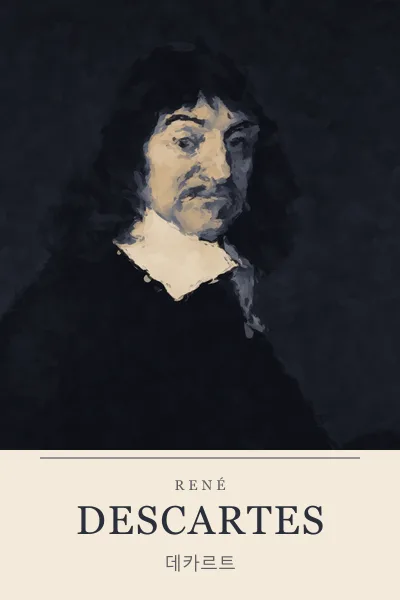
Discourse on the Method: Four Rules
방법서설: 네 가지 규칙
René Descartes (1596–1650)
The Story
Tap a word to translate it. Select text to highlight it or add it to your study plan.
In the winter of 1619, the young Descartes was with an army in Germany, shut up all day alone in a warm room.There, with no one to talk to, he had time to think about how to find the truth.
“One of my first thoughts was that work done by many hands is seldom as perfect as work done by one master.Buildings planned by a single architect are usually more beautiful and convenient than those that many people have tried to improve by using old walls for new purposes.In the same way, old cities that grew from villages are badly laid out compared with towns planned by one designer on an open plain.So I decided to clear away all the opinions I had accepted until then, and to rebuild my beliefs on foundations of my own.
A state is best governed by a few laws that are strictly kept, and so, instead of the many rules of logic, I decided that four would be enough, if I firmly resolved never to break them.The first was never to accept anything as true unless I clearly knew it to be so, avoiding hurry and prejudice.The second was to divide each difficulty into as many parts as possible.The third was to think in order, starting with the simplest and easiest things and climbing step by step to the most complex.The last was to make my lists so complete and my reviews so general that I could be sure nothing had been left out.”
Full translationTry the story first — open this only to check your understanding.
1619년 겨울, 젊은 데카르트는 독일에서 군대와 함께 있었고, 따뜻한 방에 온종일 혼자 틀어박혀 있었어요. 말 상대도 없는 그곳에서 데카르트는 진리를 찾는 법을 생각할 시간이 있었어요.
"맨 처음 떠오른 생각 가운데 하나는, 여러 사람의 손으로 한 일은 한 명의 장인이 한 일만큼 완벽한 경우가 드물다는 것이었다. 한 건축가가 설계한 건물은, 여러 사람이 낡은 벽을 새 용도로 쓰며 고쳐 보려 한 건물보다 대개 더 아름답고 편리하다. 마찬가지로 마을에서 자라난 옛 도시는, 한 설계자가 탁 트인 평지에 계획한 도시에 비해 배치가 엉성하다. 그래서 나는 그때까지 받아들인 모든 의견을 치워 버리고, 내 믿음을 나만의 토대 위에 다시 세우기로 했다.
나라는 몇 안 되는 법을 엄격하게 지킬 때 가장 잘 다스려진다. 그래서 나는 논리학의 수많은 규칙 대신, 결코 어기지 않겠다고 굳게 다짐한다면 네 가지면 충분하다고 판단했다. 첫째는 내가 분명히 참이라고 알지 못하는 것은 무엇이든 참으로 받아들이지 않으며, 성급함과 편견을 피하는 것이었다. 둘째는 각각의 어려움을 될 수 있는 대로 많은 부분으로 나누는 것이었다. 셋째는 가장 단순하고 알기 쉬운 것에서 시작하여 한 단계씩 가장 복잡한 것으로 올라가며, 순서에 따라 생각하는 것이었다. 마지막은 아무것도 빠뜨리지 않았다고 확신할 수 있도록 목록을 완전하게 만들고 전체를 두루 검토하는 것이었다."
In plain words
데카르트는 지식을 도시에 비유해요. 낡은 믿음을 덧대어 고치면 엉망이 되니, 바닥부터 꼼꼼히 다시 짓는 편이 낫다는 거예요. 네 가지 규칙은 지금도 어려운 문제에 쓰기 좋은 방법이에요. 의심하고, 나누고, 순서를 세우고, 점검하라. 큰 문제를 작은 부분으로 쪼개라는 둘째 규칙은 오늘날 과학자와 공학자와 프로그래머가 일하는 방식의 바탕이에요. 핵심은 첫째 규칙이에요. 남들이 믿는다는 이유만으로 아무것도 받아들이지 말라는 거예요.
Original text
Now read the original
You just read an easy retelling. Here is the same passage exactly as the author wrote it — unabridged, split into short readings.
Part II · 3,333 words · 7 short readings
Read the originalComprehension Check
1. Why are buildings planned by one architect usually better?
2. What did Descartes decide to do with the opinions he had accepted?
3. What is the first of Descartes's four rules?
4. What does the second rule tell you to do with a difficulty?
5. Why did Descartes choose only four rules?
Vocabulary
noun
architect
건축가
The architect designed a house with large windows.
그 건축가는 창이 큰 집을 설계했어요.
Your Summary
In 1–2 sentences, explain Descartes's picture of the city, and list his four rules for thinking.
Source: Adapted from Part II of René Descartes's "Discourse on the Method" (1637), in John Veitch's English translation (long in the public domain, Project Gutenberg #59). This simplified version, the explainer and the Korean translation are original text written for SeoJae Story.
In this book
About this book →Discourse on the Method · 0 of 3 read
Up next · Part 3 of 3
I Think, Therefore I Am
나는 생각한다, 그러므로 나는 존재한다 · 2 min read
Read the next partRead this with your book club
Share this chapter with your book club and discuss it together.