
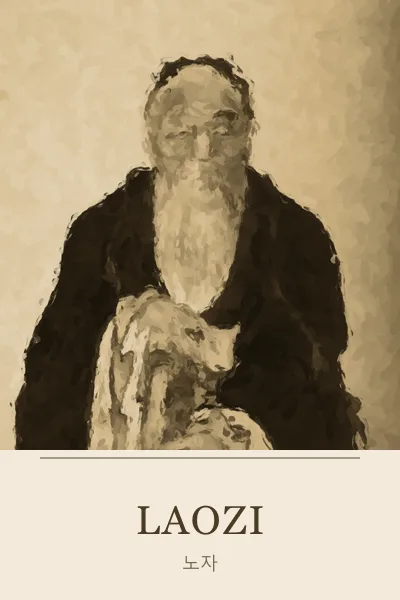
Tao Te Ching: The Way That Cannot Be Told
도덕경: 말할 수 없는 도
Laozi (6th century BC)
The Story
Tap a word to translate it. Select text to highlight it or add it to your study plan.
According to legend, Laozi was a record keeper at the Chinese royal court who grew tired of its quarrels and rode away to the west on an ox.At the border, a guard begged him to write down his wisdom first, and the result was the Tao Te Ching, a little book of eighty-one short chapters.
“The Way that can be told is not the eternal Way; the name that can be named is not the eternal name.Without a name, it is the beginning of heaven and earth; with a name, it is the mother of all things.
When everyone in the world knows beauty as beauty, ugliness appears; when everyone knows good as good, what is not good appears.So being and not-being give birth to each other; difficult and easy complete each other; long and short shape each other; high and low lean on each other.Therefore the wise person acts without forcing and teaches without words.
Thirty spokes meet at the hub of a wheel, but it is the empty space in the middle that makes the wheel useful.We shape clay into a pot, but it is the emptiness inside that holds what we want.We cut doors and windows to make a room, but it is the empty space within that lets us live in it.So what is there gives us something to use, but what is not there makes it useful.”
Full translationTry the story first — open this only to check your understanding.
전설에 따르면 노자는 중국 왕실의 기록 관리인이었는데, 궁정의 다툼에 지쳐 소를 타고 서쪽으로 떠났어요. 국경에서 한 관문지기가 먼저 지혜를 글로 남겨 달라고 간청했고, 그렇게 나온 것이 81개의 짧은 장으로 된 작은 책 『도덕경』이에요.
"도를 도라고 말할 수 있으면 영원한 도가 아니고, 이름을 이름이라 부를 수 있으면 영원한 이름이 아니다. 이름이 없을 때 그것은 하늘과 땅의 시작이고, 이름이 있을 때 그것은 만물의 어머니다.
세상 사람들이 모두 아름다운 것을 아름답다고 알면 추한 것이 생겨나고, 모두 선한 것을 선하다고 알면 선하지 않은 것이 생겨난다. 그러므로 있음과 없음은 서로를 낳고, 어려움과 쉬움은 서로를 이루며, 긴 것과 짧은 것은 서로를 드러내고, 높은 것과 낮은 것은 서로 기댄다. 그래서 성인은 억지로 하지 않으면서 일을 처리하고, 말없이 가르친다.
서른 개의 바퀴살이 바퀴통에 모이지만, 바퀴를 쓸모 있게 하는 것은 그 가운데의 빈 공간이다. 진흙을 빚어 그릇을 만들지만, 우리가 원하는 것을 담는 것은 그 안의 빈 곳이다. 문과 창을 뚫어 방을 만들지만, 그 안에서 살 수 있게 하는 것은 안의 빈 공간이다. 그러므로 있는 것은 쓸 거리를 주지만, 없는 것이 그것을 쓸모 있게 한다."
In plain words
도(道), 곧 '길'은 모든 것 뒤에 숨은 흐름이에요. 노자는 그것을 말로 붙잡으려는 순간 놓치게 된다고 말해요. 반대되는 것들은 서로가 필요해요. '추함' 없이는 '아름다움'도 없고, '낮음' 없이는 '높음'도 없어요. 바퀴와 그릇과 방은 빈 것이 아무것도 아닌 게 아니라는 걸 보여 줘요. 빈 공간과 침묵과 쉼이 있어야 일이 돌아가요. '억지로 하지 않음(무위)'은 노자의 핵심 생각이에요. 자연처럼, 필요한 일을 하고 나면 물러나라는 거예요.
Original text
Now read the original
You just read an easy retelling. Here is the same passage exactly as the author wrote it — unabridged, split into short readings.
Chapters 1–11 · 1,291 words · 3 short readings
Read the originalComprehension Check
1. According to legend, why did Laozi write the Tao Te Ching?
2. What does Laozi say about 'the Way that can be told'?
3. What happens when everyone knows beauty as beauty?
4. What makes a wheel useful, according to Laozi?
5. How does the wise person teach?
Vocabulary
noun
legend
전설
According to legend, a dragon lived in this lake.
전설에 따르면 이 호수에는 용이 살았어요.
Your Summary
In 1–2 sentences, say what Laozi means by the Way, and what the wheel, the pot and the room show about emptiness.
Source: Adapted from chapters 1, 2 and 11 of the "Tao Te Ching" attributed to Laozi (c. 4th century BC), in James Legge's English translation (long in the public domain, Project Gutenberg #216). This simplified version, the explainer and the Korean translation are original text written for SeoJae Story.
In this book
About this book →Tao Te Ching · 0 of 3 read
Up next · Part 2 of 3
Be Like Water
물처럼 · 2 min read
Read the next partRead this with your book club
Share this chapter with your book club and discuss it together.