
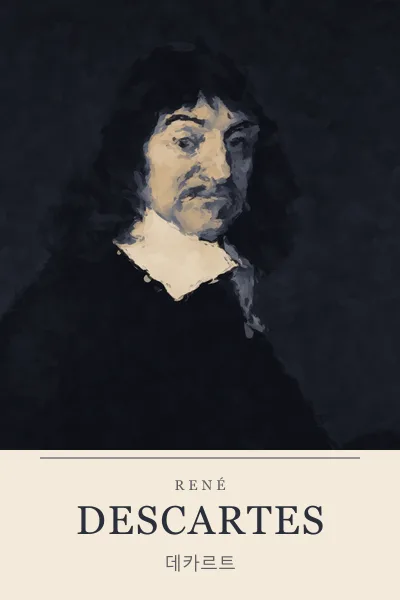
Discourse on the Method: I Think, Therefore I Am
방법서설: 나는 생각한다, 그러므로 나는 존재한다
René Descartes (1596–1650)
이야기
단어를 탭하면 번역돼요. 문장을 선택하면 형광펜을 칠하거나 학습 계획에 추가할 수 있어요.
While he rebuilt his beliefs, Descartes still had to live, so he gave himself a few simple rules for daily life.
“My second rule was to be as firm and decided in my actions as I could, like travellers who are lost in a forest.They should not wander this way and that, and still less stay in one place, but walk as straight as they can in one direction; in this way they will at least come out somewhere better than the middle of a forest.My third rule was always to try to conquer myself rather than fortune, and to change my desires rather than the order of the world.
Then, because I wanted to search only for the truth, I decided to reject as false everything in which I could imagine the slightest doubt.Our senses sometimes deceive us, so I supposed that nothing was really as they showed it.People make mistakes in reasoning, so I rejected all the proofs I had accepted before.And since the same thoughts we have when awake can come to us in dreams, I supposed that everything that had ever entered my mind was no more true than my dreams.
But at once I noticed that, while I was thinking that everything was false, I, who was thinking it, had to be something.This truth, I think, therefore I am, was so firm and certain that not even the wildest doubts could shake it.So I decided that I could safely accept it as the first principle of the philosophy I was looking for.”
전체 번역먼저 이야기를 읽어 보고, 이해했는지 확인할 때만 열어 보세요.
믿음을 다시 세우는 동안에도 데카르트는 살아가야 했기에, 일상을 위한 간단한 규칙 몇 가지를 정했어요.
"나의 둘째 규칙은 숲에서 길을 잃은 여행자처럼, 행동할 때 될 수 있는 대로 굳고 단호하게 하는 것이었다. 여행자는 이리저리 헤매서도 안 되고 한곳에 머물러서는 더더욱 안 되며, 한 방향으로 될 수 있는 대로 곧게 걸어야 한다. 그러면 적어도 숲 한가운데보다는 나은 어딘가에 이르게 될 것이다. 셋째 규칙은 언제나 운명보다 나 자신을 이기려 하고, 세상의 질서보다 내 욕망을 바꾸려 하는 것이었다.
그다음 나는 오직 진리만을 찾고 싶었기에, 조금이라도 의심할 여지가 있다고 상상할 수 있는 것은 모두 거짓으로 여겨 버리기로 했다. 우리의 감각은 때때로 우리를 속이므로, 나는 어떤 것도 감각이 보여 주는 그대로는 아니라고 가정했다. 사람은 추론에서 실수를 하므로, 나는 전에 받아들였던 모든 증명을 버렸다. 그리고 깨어 있을 때 하는 생각이 꿈에서도 똑같이 찾아올 수 있으므로, 내 마음에 들어왔던 모든 것이 내 꿈보다 더 참될 것이 없다고 가정했다.
그러나 곧바로 나는, 모든 것이 거짓이라고 생각하는 동안에도 그렇게 생각하는 나는 무언가여야만 한다는 것을 알아차렸다. '나는 생각한다, 그러므로 나는 존재한다'는 이 진리는 너무나 굳건하고 확실해서 아무리 터무니없는 의심도 흔들 수 없었다. 그래서 나는 이것을 내가 찾던 철학의 제1원리로 안심하고 받아들여도 된다고 결론지었다."
쉽게 말하면
길 잃은 여행자는 실용적인 교훈을 줘요. 확신할 수 없을 때는 제자리를 맴돌기보다 한 방향을 정해 계속 가라는 거예요. 확실성을 찾기 위해 데카르트는 모든 것을 의심해요. 감각도, 추론도, 심지어 지금 깨어 있는지조차도요. 그런데 의심하는 것도 생각의 한 가지이고, 생각하려면 존재해야 해요. 그래서 '나는 생각한다, 그러므로 나는 존재한다'는 의심할 수 없는 단 하나예요. 라틴어로 cogito, ergo sum이라고 하는 이 유명한 문장은 근대 철학의 출발점이 되었어요.
원문
이제 원문으로 읽어 보세요
방금 읽은 건 쉽게 다시 쓴 이야기예요. 이번엔 작가가 쓴 그대로의 원문을 줄이지 않고, 짧게 나눠서 읽어 보세요.
Parts III and IV · 5,393 단어 · 12 개의 짧은 읽기
원문 읽기이해도 확인
1. What should travellers lost in a forest do, according to Descartes?
2. What was Descartes's third rule for daily life?
3. Why did Descartes decide to doubt his senses?
4. Why did Descartes compare his waking thoughts to dreams?
5. What could not be doubted, even if everything else was false?
핵심 단어
verb
wander
헤매다, 돌아다니다
We wandered around the old town all afternoon.
우리는 오후 내내 구시가지를 돌아다녔어요.
한줄 요약
In 1–2 sentences, explain the lost traveller's lesson, and how Descartes reached 'I think, therefore I am'.
출처: Adapted from Parts III and IV of René Descartes's "Discourse on the Method" (1637), in John Veitch's English translation (long in the public domain, Project Gutenberg #59). This simplified version, the explainer and the Korean translation are original text written for SeoJae Story.
이 책의 이야기
책 소개 →Discourse on the Method · 3편 중 0편 읽음
지금까지 준비된 이야기를 모두 읽었어요. 새로운 챕터가 곧 추가돼요.
북클럽과 함께 읽기
이 챕터를 북클럽과 공유하고 함께 이야기 나눠요.